

What Is Somatic Healing?
(And Why Your Body Has Been Waiting for You to Ask)

A note before we begin: this is a longer foundation piece and may take some time to read. My intent was to map the territory of somatic healing as I've come to understand it. Woven throughout are images from a visual series I'm calling Nature as Nervous System: a way of seeing the body's intelligence reflected in the living world around us. They aren't illustrations of the text so much, but rather a parallel language, holding what words can only point toward. Please read slowly and let the images speak as much as the words do.
In 2003, I almost skipped a book that changed my life: Waking the Tiger: Healing Trauma, by somatic pioneer Peter Levine.
At that point, I was fresh out of art school at NYU, where I’d been studying physical approaches to acting. I’d spent years cultivating my body’s expressive capacity through movement, breath, vocal training, and yogic practice. I wanted so badly to be a clear channel for emotions to flow through me. But there were tensions, inhibitions, and anxieties that created friction, not just in the craft of acting, but in living life.
As a trauma survivor, acting had given me a path to tap into emotions that had long been suppressed. I knew instinctively that energy was still stored in my body and that it impacted my ability to let emotions move through me authentically. More than that, I knew the residue of those past experiences affected my confidence and my capacity to simply be in the world.
I’d done enough inner work to name my patterns. But I’d hit a plateau. Parts of me still felt cut off, frozen, and numb.
There was a simple exercise in the book that helped me understand why.
Levine observed that animals instinctively discharge overwhelming energy from their bodies after a threat, but that in humans this instinct is often stifled by conditioning. Part of that conditioning, he reasoned, is the survival strategy of dissociation. The body learns, in the face of overwhelming experience, to step back from sensation in order to stay safe. Over time, that protective distance can quietly solidify into a feeling that the body isn’t really ours.
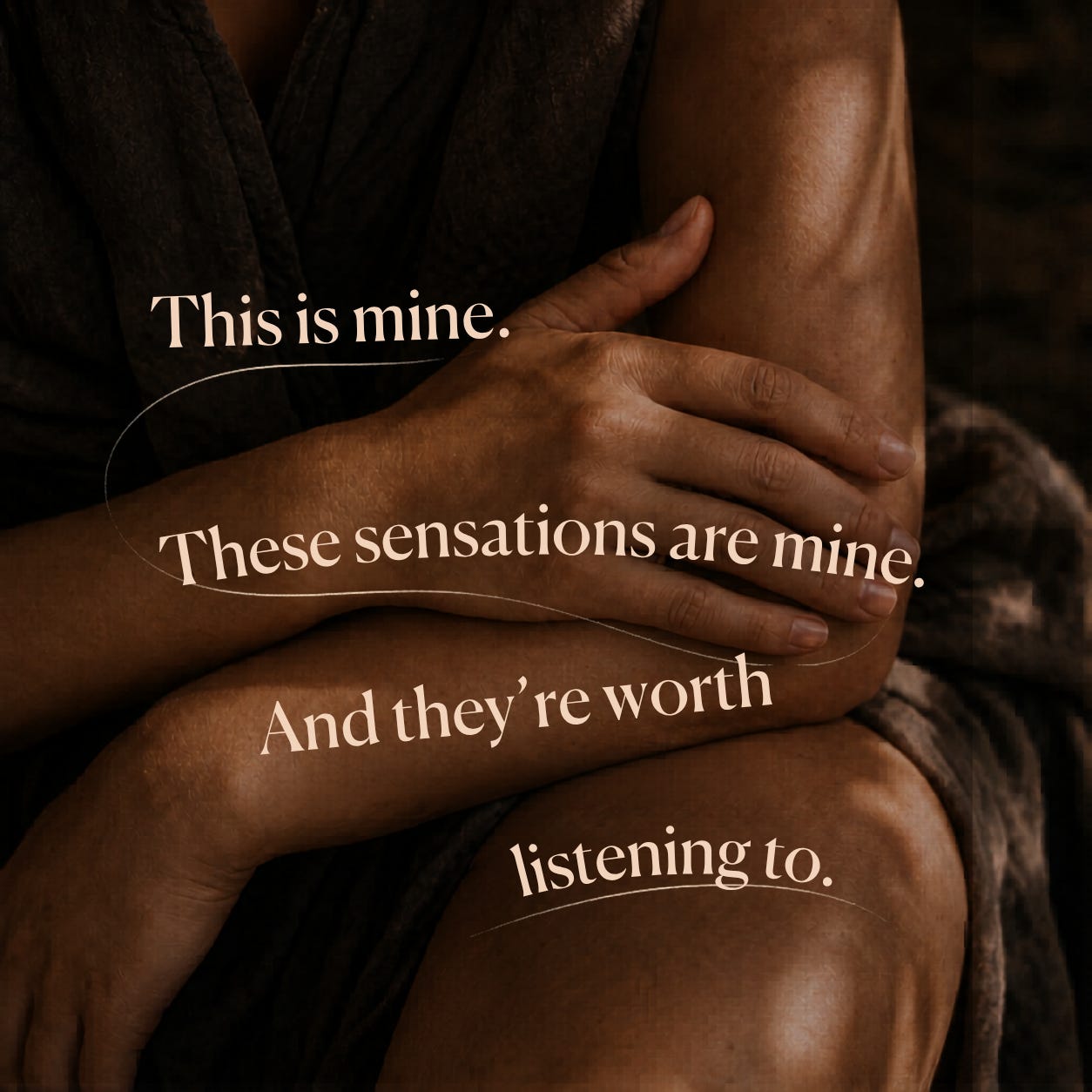
To counter this, he suggested standing in the shower and, as the water touches each part of the body, naming it quietly, internally. My arm. My legs. My neck. Each part acknowledged, claimed, and met with attention and autonomy.
As much work as I’d done with my body through acting, I’d never considered the need to reclaim it. I had always thought of it as a vessel for emotions to flow, in service of the audience, in service of the art—never simply in service of being human.
It sounds almost too simple to matter. But this shift in focus felt empowering in a way I hadn’t quite experienced before. His premise of awakening the tiger inside, of overriding the signals of shutdown through tactile reclaiming, landed deeply.
That exercise became a touchstone as well as a reminder that others were struggling to inhabit their bodies as I was and that the clinical world was beginning to acknowledge this need as well.
This calling would evolve over more than two decades of somatic practice and inquiry, eventually leading me to develop my own approach, which I call Haptic Body.
What follows is a deeper dive into what I’ve come to understand about somatic healing and why I believe it may be one of the most important resources available to us right now.
So what does “somatic” actually mean?
Soma means body. Somatic healing is the path of returning to the body. The same body that’s been through everything, quietly carrying its own record.
Not to decode what it’s holding or to analyze why. To meet it. To feel what’s actually there.
This sounds simple. In a culture that has placed its deepest trust in thinking, in naming, understanding, and reasoning our way through experience, it is also quietly radical.
Because the nervous system doesn't resolve experience through thought. It resolves it through sensation. Through movement. Through the quality of felt safety in the present moment, in the tissue, in the breath.
Many of the people drawn to this work are extraordinarily good at thinking. At tracking patterns, reading context, sensing what’s happening beneath the surface of a room or a relationship. That capacity is real, and it’s valuable. And it can also become its own kind of prison. The mind circling the same territory, understanding everything and shifting nothing, because the body hasn’t been part of the conversation.
What I found in that shower, what so many people find when they first turn toward the body with genuine attention, is that something has been waiting. Patiently. For longer than we realized.
The body is teeming with life
Beneath the skin, the body is not still.
It is threaded through with intelligence, a vast, continuous web of fascia that wraps every muscle, every organ, and every bone in a living matrix of connective tissue. This isn’t simply structural scaffolding. Fascia carries the imprint of how you move, how you brace, and how you hold yourself against the world. It learns. It adapts. And it responds to more than motion — it responds to the life you’ve lived.
Woven through this fascial web is the nervous system itself. The vagus nerve — one of the longest and most complex nerves in the body — travels from the brainstem down through the throat, the heart, the lungs, and deep into the gut, branching into nearly every major organ along the way. It is the body’s primary channel of communication between what happens inside and what the brain understands as safe or unsafe, open or defended, alive or shut down.
When something overwhelming happens, something the body you live inside doesn’t have the resources to fully process in the moment, the response is the only one available. It protects. It braces. It contracts around the experience, holding it in tissue until conditions feel safe enough to release.
This is what Levine understood so clearly in Waking the Tiger. Animals in the wild complete this cycle naturally. The charge that moves through them during a threat discharges through shaking, trembling, and movement. The energy completes its arc, and the body returns to baseline. But humans, shaped by social conditioning and the learning that certain expressions aren’t safe or welcome, often interrupt that cycle. The charge has nowhere to go. And so it lives on in the fascia, in the muscle tone, in the quality of the breath, and in the parts of the body that feel cut off, frozen, or numb.
For those who learned early to track others carefully, to adapt quickly, to translate themselves across different environments, this holding can run especially deep. The body that became exquisitely attuned to its environment often did so at the cost of its own interior. Sensitivity turned outward, away from its own signals, toward the signals of everyone else.
Many of us learned, somewhere along the way, to become very good at not showing what we felt. The body stops processing what it can't express. And over time, that unprocessed charge accumulates, not as drama, not as breakdown, but as a low-grade tightening.
This is where low-dose somatic work becomes quietly powerful. Not because it will shift you immediately into some perfectly embodied state. It won’t, and anything promising isn’t worth your trust. But because it creates the conditions for emotions to metabolize, little by little, at a pace the body you live inside can actually tolerate. Small amounts of sensation, met with attention. Small moments of contact. And over time, something that felt permanently frozen begins, almost imperceptibly, to move.
I recognized this in myself long before I had language for it. As a young performer, I found in certain roles a kind of sanctioned dropping inward, a freedom in my reflexes, that ordinary life had never quite offered. The stage gave me a field where full expression was not just permitted but celebrated. And then I would leave, and the old adaptations would quietly reassemble.
By the time I arrived at NYU, immersed in physical approaches to acting and eventually winning the departmental award, I had spent years returning to that feeling. Trying to understand why expression felt so alive inside performance and so constrained everywhere else.
That question never left me. And in many ways, the work I do now, the Haptic Body approach, this publication, and everything I’ll be sharing here are my life’s attempt to answer it. To find the bridge between those two worlds. And to make it available to anyone who has ever felt that same schism, whether they’ve stepped on a stage or not.
What somatic healing works with, at its most essential, is that interrupted arc. The charge that never completed. The expression that never fully moved through.
How touch and voice speak to the nervous system
The skin is lined with a specialized network of nerve fibers called C-tactile afferents, fibers that respond specifically to slow, gentle, caring touch. Think of the back of a warm hand gliding down the outside of your forearm at the pace of a slow exhale, just enough pressure to stir the fine hairs but not enough to press into muscle.
Self-touch activates the same pathway and, for many people, is often the safest place to begin. Light, slow touch is one route; deep, steady pressure can also be profoundly grounding. A weighted blanket, a firm hand, or simply leaning your back into a wall.
When activated, these forms of touch send signals directly to the parts of the brain involved in safety and social connection, helping to shift the body out of a defended state and into one of greater openness and regulation.
Touch, in this sense, isn't comfort. It's one of the most direct forms of communication with the body's own intelligence that we have access to.
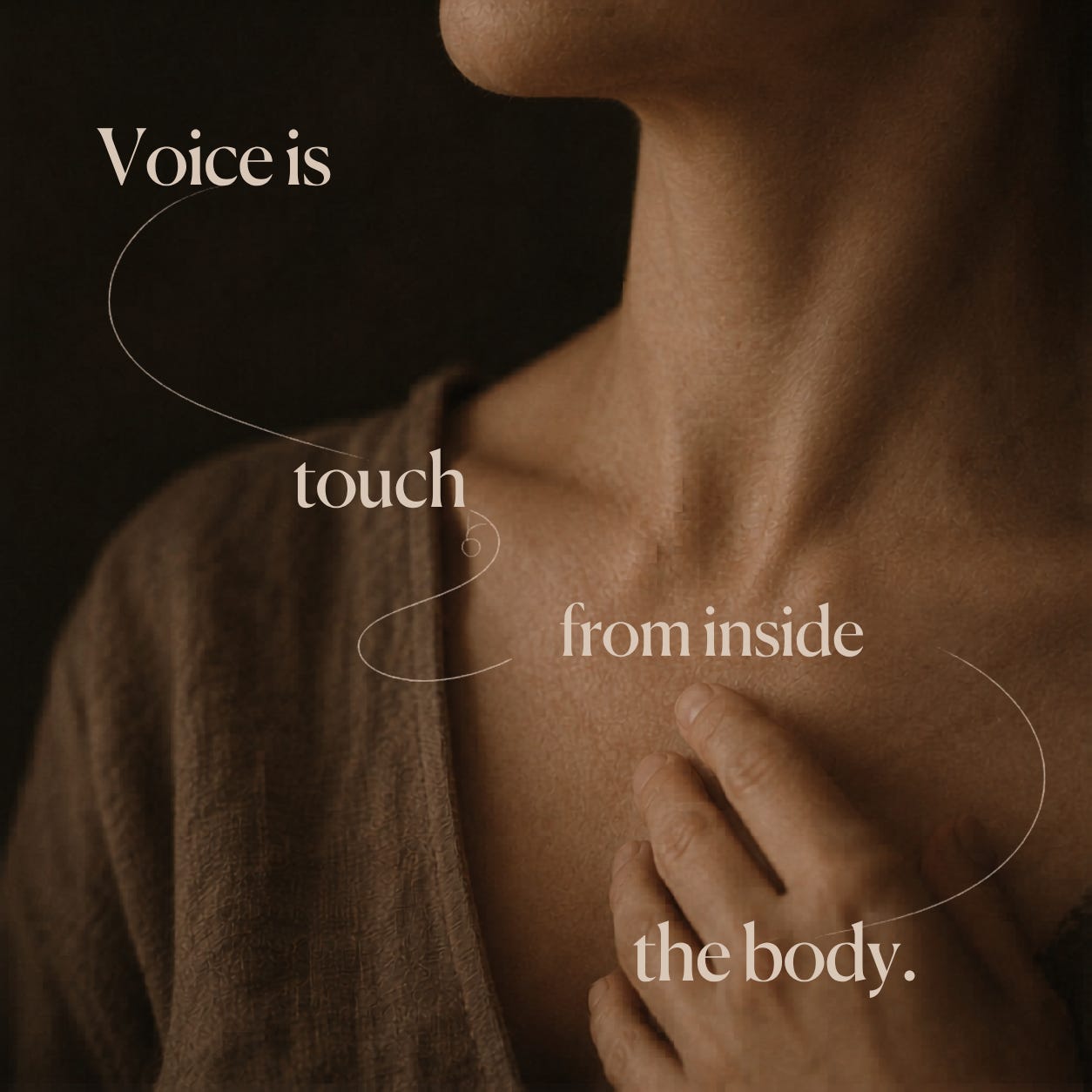
The voice works in a similar way. Voice is touch from inside the body—vibration moving through tissue. Humming, toning, or speaking from a grounded, resonant place engages the vagus nerve directly through the muscles of the throat and larynx and pairs naturally with a longer exhale.
For many people, especially those who have spent years carefully calibrating how they express themselves, this can be one of the most quietly revelatory entry points into the body.
Sound works from the outside in the same way. When we’re held in sound, whether that’s the resonance of a singing bowl, the low frequency of a drum, or even the quality of a voice that carries genuine presence, the body receives it not just through the ears but through the skin itself.
Nestled deep within the layers of the skin are receptors called Pacinian corpuscles, pressure-sensitive nerve endings that respond specifically to vibration. They’re among the most sensitive receptors in the body, capable of detecting frequencies from the ground beneath your feet, the hum of an instrument, or the reverberation of sound moving through a room. When vibration reaches them, it travels inward, through tissue, through fascia, and into the deeper architecture of the body.
This is why sound healing can be so disarmingly effective. It isn’t working on the mind. It’s working directly on the tissue. Meeting the body in the language it already understands. And for those who find touch difficult to receive, or whose defenses are strong enough that direct contact feels like too much, sound offers another way in. Gentler, less direct, but no less real.
It’s a territory I find endlessly alive in my own work, the way certain frequencies can reach places that hands sometimes can’t, and how combining sound with touch creates a kind of layered conversation with the body that neither can quite achieve alone.
The first time I understood this viscerally was when I began working with my own voice not as a performance instrument but as a healing one. I discovered that vibration could meet bone and tissue in a very precise way, shifting tensile patterns from the inside out in real time. Around the face, the palate, the skull, something would release and I would feel it cascade through the rest of the body.
What I hadn’t expected was what accompanied that release. Not just relief. Something closer to joy. The joy of a body moving into fuller expression, of energy that had been held becoming energy that was alive and available.
This is what I’ve come to understand about the face specifically. It sits at the top of the body’s architecture. And the face mirrors the rest of the structure in precise ways. The palate reflects the pelvic floor, the cheekbones mirror the rib cage, the jaw holds what the hips hold. As tensions in the face begin to release, that release cascades downward. Working at the top of the architecture, gently and with attention, can shift the whole.
What does somatic healing actually look like?
It doesn’t always look like what you might expect.
There’s no script to follow. No particular position to hold. Sometimes it’s as simple as pausing in the middle of an ordinary moment and noticing, really noticing, what’s happening in your body right now.
The weight of your feet on the floor. The quality of your breath. Whether your jaw is holding something your thoughts haven’t caught up to yet.
That noticing is not passive. It’s the beginning of a conversation.
Because the body responds to attention. When you bring embodied awareness to a place of tension or holding, something begins to shift. It helps to distinguish this from mindful awareness, though the two are often confused. Mindful awareness observes. It notices what’s happening from a slight distance, with a quality of calm detachment. Embodied awareness goes further. It drops into the felt experience itself, sensation, emotion, and all, inhabiting rather than witnessing.
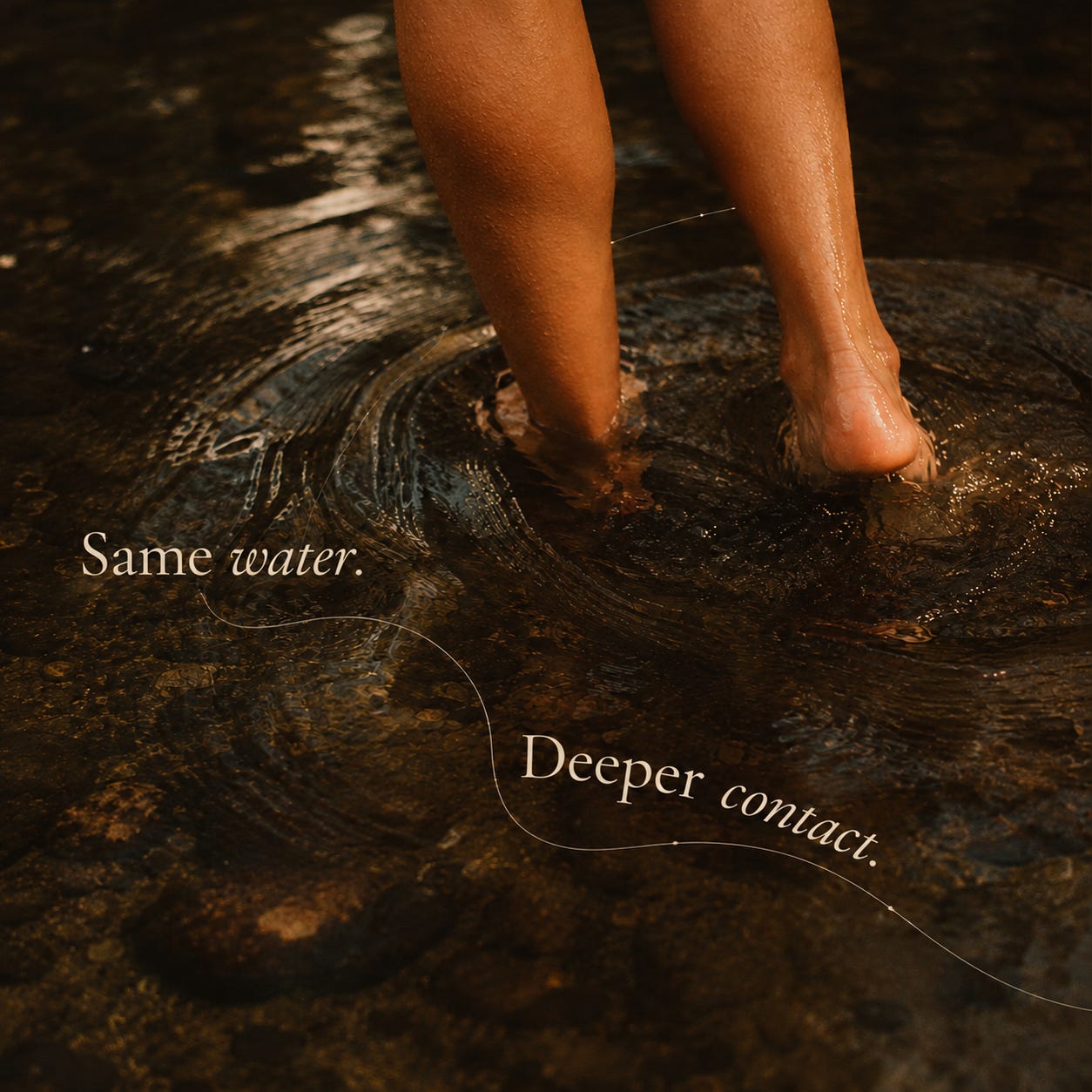
Think of it this way. Mindful awareness is standing at the edge of the water, feeling the temperature with your toe. Embodied awareness is wading in, feeling it rise around your ankles, your legs, and your whole body adjusting to meet it.
Same water. Completely different experience.
In practice, somatic healing might look like breathwork that helps the body move out of bracing and into settling. It might look like slow, intentional touch, your own hands on your own skin, sending a signal of safety through pathways that have learned to hold. It might arrive through bodywork, where something unexpected surfaces mid-session, an emotion that moves through and leaves you feeling lighter, clearer, more like yourself.
That isn’t incidental. That’s the body completing something it had been holding, waiting for the right conditions of safety and touch to finally let it go.
Or it might come somewhere you least expected it. An improv class where you stepped into a completely different character and felt a boldness move through you, something that felt less like pretending and more like remembering. Or your own voice, humming in the car or singing a song after a breakup, and feeling something in your chest quietly shift. Not because the sadness was gone. Because it finally had somewhere to go.
The common thread isn’t the technique.
It’s the quality of attention: curious, patient, and willing to feel.
And what tends to happen when that quality of attention meets the body consistently is something researchers call regulation, a returning to a natural baseline. More space in the breath. A softening of chronic tension. A sense of being more fully here, more recognizably yourself.
Because something was finally felt.
Claiming the body as yours
When we meet the body with care, really meet it in the tissue, in the actual felt landscape of it, something begins to shift that thinking alone can’t reach.
Many of us have had experiences that made it feel safer to leave. To float somewhere above the body, watching from a distance, managing from the outside. That response is intelligent. It’s the body doing exactly what it needed to do. But over time, that distance can quietly reinforce a story that the body isn’t quite ours. That it’s something that happens to us rather than something we live inside.
For those who spent years learning to read the room, to adapt, to translate themselves across different environments, that distance can feel entirely normal. The attention that learned to track everything outside can make the interior feel like unfamiliar territory. Not lost. Just long unvisited.
Somatic healing is the gradual undoing of that distance. Through contact. Through sensation. Through learning to meet each part of the body where it actually is, with curiosity, with tenderness, with care, and in doing so, slowly claiming it back.
And what emerges through that claiming is not what most people expect. Something more alive than calm. An intelligence that was always there, waiting beneath the holding, the bracing, the years of managing. The body as a partner in this experience of life rather than a problem to be solved.
Emotions, met this way, stop feeling like something you are and begin feeling like something you’re moving through.
The body stops being a source of confusion or disconnection and becomes a source of information, of wisdom, of an aliveness that is entirely your own.
As contact deepens, your whole being remembers how to open, and the bandwidth for pleasure, for warmth, for connection, and for the felt sense of yes grows by degrees.
What surprised me most, in my own healing and in working with others, is that this release doesn’t deplete. When emotion that has been held finally gets to move and when the body stops spending so much energy on containment, what arrives isn’t exhaustion. It’s a more expanded baseline. A greater capacity to hold the full range of what it means to be human.
Think of tears. To cry, the body has to be in a certain state of openness. When we’re contracted, numb, braced, tears stay inside. They’re there, but your whole being is too defended to let them through. It’s only when something softens, when there’s a kind of surrender into the space that’s already there, that they can finally flow. And when they do, even when the sadness underneath is real, there’s almost always something else present too. A relief. An opening. Something that feels, quietly and unmistakably, like joy.
Not because the pain is resolved. But because the body is moving again.
Joy and sorrow turn out to be less like opposites and more like ballast for each other, each one making the other possible, each one proof that something in you is still alive enough to feel.
This is why we cry at weddings as much as at funerals. Why deep laughter can bring tears, and why grief, fully felt, can hold moments of unexpected lightness. These aren't contradictions. They're two ends of the same open channel. When the body is defended, neither can move through fully. When it softens, both can.

The energy that had been quietly consuming your whole being in the work of containment releases back as presence. As aliveness. Our culture tends to rank emotions, welcoming some, suppressing others.
What embodiment work teaches, slowly and undeniably, is that there is joy underneath if we allow ourselves the internal support to blossom into feeling.
In the grief that finally moves. In the anger that finds its shape. In the tenderness that stops protecting itself. The joy isn’t the absence of difficulty. It’s the aliveness of being in full contact with your own experience.
The body doesn’t just hold emotion. It holds expression that never felt safe.
In the face, in the voice, in the places where we learned to go quiet, where a jaw tightened around something unspoken, where a throat closed around a sound that didn’t feel permitted. This is where so much of the holding lives. And it’s where, with the right quality of attention and contact, so much of the releasing begins.
This is the territory we’ll be exploring together here. Each part of the body met with care. Each layer of holding approached with patience. The intelligence that lives beneath, uncovered gradually, tended over time.
How somatic healing relates to other approaches
Talk therapy has been part of my own healing for years. The best therapists I’ve worked with weren’t the ones who analyzed my experience. They were the ones who witnessed it. Who asked the right questions and created enough space for certain emotions to find language, often for the first time. There’s something quietly powerful about being seen by another person in that way. It’s its own form of regulation.
And yet. There were things that found language in those rooms and still didn’t shift in the body. Insights that were real and true and somehow insufficient. Not because the therapy failed, but because understanding and metabolizing are two different things. The body needed its own pathway through.
Somatic healing isn’t a replacement for talk therapy. It’s one of its most powerful companions.
This is especially true for people who are highly verbal and analytically skilled, those who can articulate their patterns with precision and still feel them running unchanged beneath the surface. The insight is real. The body simply hasn’t received it yet.
Understanding and metabolizing are two different things.
This is where somatic healing steps in. To meet what therapy has opened at the level of sensation, breath, tissue, and the body’s own response. To help what has been named finally be felt and, through feeling, released. Many clinicians are integrating body-based methods for exactly this reason, a recognition that lasting healing often requires working with the body as well as the mind.
I’ve had my own experiences with plant medicine, and what I can say honestly is that they gave me access to what I can only describe as the constellation of my thinking and my embodied being, a wider view of my own patterns than I could reach in ordinary states.
Certain paradigms of control that had been embedded very deeply, which I hadn’t even recognized as control, became visible and then, in some cases, released.
What I found was that this release was only sustainable because something in the body had also shifted. The insight needed somewhere to land. Something in me needed to learn, slowly and through felt experience, that it was safe to exist without the structures it had spent years quietly building around itself.
This is what integration means to me. Not processing what happened intellectually. Letting the body you live inside catch up with what opened.
Across all of these approaches, therapy, plant medicine, ceremonial work, and somatic healing offer the same thing.
A way back into the body.
Where the completion happens.
Why somatic healing matters more now than ever
Something has shifted in the last decade or two. Most of us can feel it even if we haven’t quite named it.
The erratic pace of information has moved beyond what our minds were designed to absorb. Screens are constant. The news cycle never stops. Attention is pulled continuously outward, toward a notification, toward the next story, toward the ambient hum of a world that never quite goes quiet. And with every pull outward, something is pulled away from the body. Away from sensation.
Away from the internal compass that knows, before the mind catches up, what is actually true.
For those already wired to track and process and adapt, this environment is particularly taxing. The body that learned to read everything can find itself overwhelmed by everything. The sensitivity that was once a survival skill becomes a source of chronic overload.
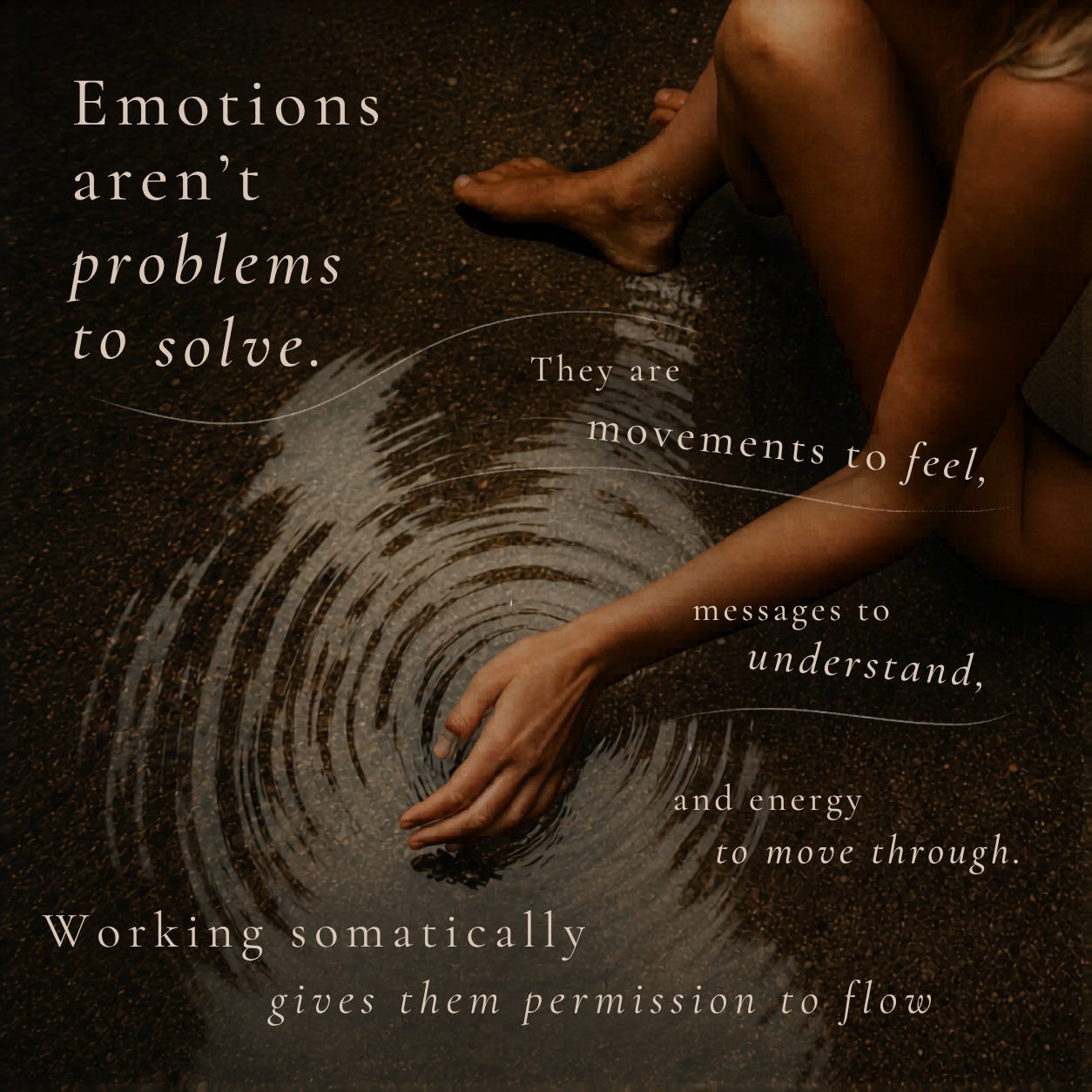
The result, for many people, is a kind of low-grade disorientation. A feeling of being slightly outside yourself. Of managing rather than inhabiting. Of searching for clarity in more information when the clearest signal available is already here, beneath the sternum, in the quality of the breath, in what the body quietly registers before the thinking begins.
Working somatically in this environment isn't just personally meaningful. It becomes a kind of orientation. A way of returning to your own signal amid a great deal of noise.
This is the intention I'm setting with The Embodiment Guide and what I hope to create here. The work isn't only about healing what's been held in the body. It's about learning to meet technology, information, and modern life from a more embodied place so that the tools we use don't use us and the noise outside never fully drowns out what the body knows.
Somatic healing, in this context, is simply the most clarifying thing available to us right now.
Who is somatic healing for?
Some of the people most naturally suited to somatic healing have been doing a version of it their whole lives without knowing it had a name.
Actors and singers, for instance. People who have spent years learning to drop out of their heads and into their bodies. To let emotion move through rather than to manufacture it. To feel the difference between a voice that carries genuine presence and one that’s technically correct but somehow doesn’t land. That sensitivity, that already developed relationship with the body as an instrument of expression, is exactly the foundation somatic healing builds from. For this group, the work often feels less like learning something new and more like coming home to something they already know at a deeper level.
It’s also for the highly sensitive. The ones who feel everything a little more than seems socially acceptable and who learned to turn the volume down on their own experience in order to function. The ones who became so attuned to others that their own interior became harder to access.
For the neurodivergent thinker who moves through the world associatively and nonlinearly, tracking patterns others miss, and who may carry significant tension in the body from years of translating themselves into forms that don’t quite fit.
For the high-achiever who has built a life on mental capacity and is starting to notice what that has cost the body. For the caregiver who has given so much outward attention that inward attention feels almost foreign. For the founder, the creative, the deep feeler who senses that something important lives just below the surface of what they can currently access.
For anyone who has done the analysis and hit a ceiling. Who understands their patterns and still feels them running. Who has tried mindfulness and sensed that something is still missing, a deeper layer waiting to be met not through observation but through contact.
I’ll be honest about something. I’m still crossing this bridge myself. Teaching this work doesn’t mean I’ve arrived somewhere beyond it. It means I’ve found a way to keep moving through it and to bring others along. There are still moments when I feel my own masking reassemble. Still contexts where full expression doesn’t feel safe enough to land in.
This writing is part of my own practice. A scaffold for expression that I’m still learning to trust. And if that’s where you are too, somewhere between understanding and arrival—between the self the world sees and the one still waiting to be felt—then you’re exactly where this work begins.
And honestly, for anyone who has ever felt, even briefly, more fully themselves. And wants to find their way back there.
A note on timing and readiness
Somatic healing isn’t always the right first step, and knowing that is part of what makes it trustworthy.
If you’re currently in acute crisis or navigating severe depression, active trauma, or unstable circumstances, stabilization and professional support come first. The body’s capacity to brace and protect is intelligent, and sometimes that protection is exactly what’s needed before deeper work begins.
Active substance dependence, high dissociation, or certain health conditions may also mean that gentler entry points are worth exploring first, ideally with a trauma-informed guide.
The green lights are worth looking for before going deeper: a baseline of safety in daily life, access to some form of support, and the ability to genuinely slow down. Even a small felt sense of yes is enough to begin.
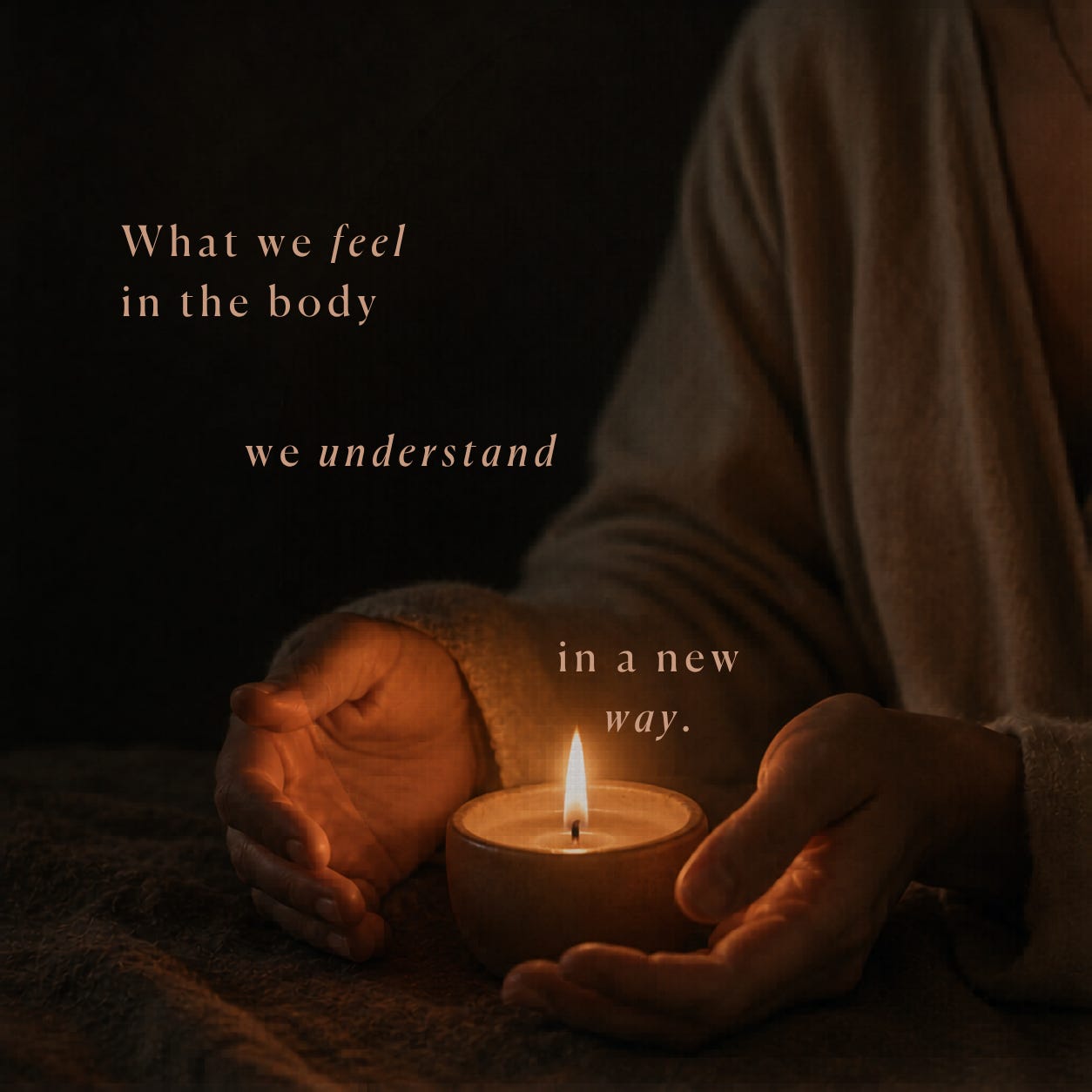
For everyone else, and for those for whom now isn’t quite the moment, small doses are always available. Feeling your feet on the floor. Lengthening the exhale. A hand resting on your chest. Somatic healing is about timing and dosage. With the right conditions, “not yet” can always become “now”.
This is where we begin
Somatic healing is a direction, not a destination.
A gradual turning of attention toward the body, with curiosity, with care, with a willingness to feel what’s actually here. And through that turning, something begins to shift. Quietly, incrementally. In the way that real things shift. Until one day you notice you’re more inside yourself than you were before.
If I imagine the person who finds their way here for the first time, I think I know something about what they’re carrying. They’re intelligent, perceptive, probably quite good at functioning, and somewhere underneath all of that, living in a kind of schism.
Between the self that moves through the world and the self that hasn’t quite been given permission to fully arrive.
They’ve done the work. They’ve read the books, sat in the therapy rooms, and tried the practices. And something is still missing. Not because they haven’t tried hard enough. Because the bridge they’re looking for isn’t built through effort. It’s built through contact. Through small moments of genuine meeting between attention and sensation. Through finding, little by little, that continuity within themselves that no amount of understanding alone could give them.
That’s what this space is for. And if you’ve recognized yourself anywhere in this article, if something landed, even quietly, you’re already closer to that bridge than you think.
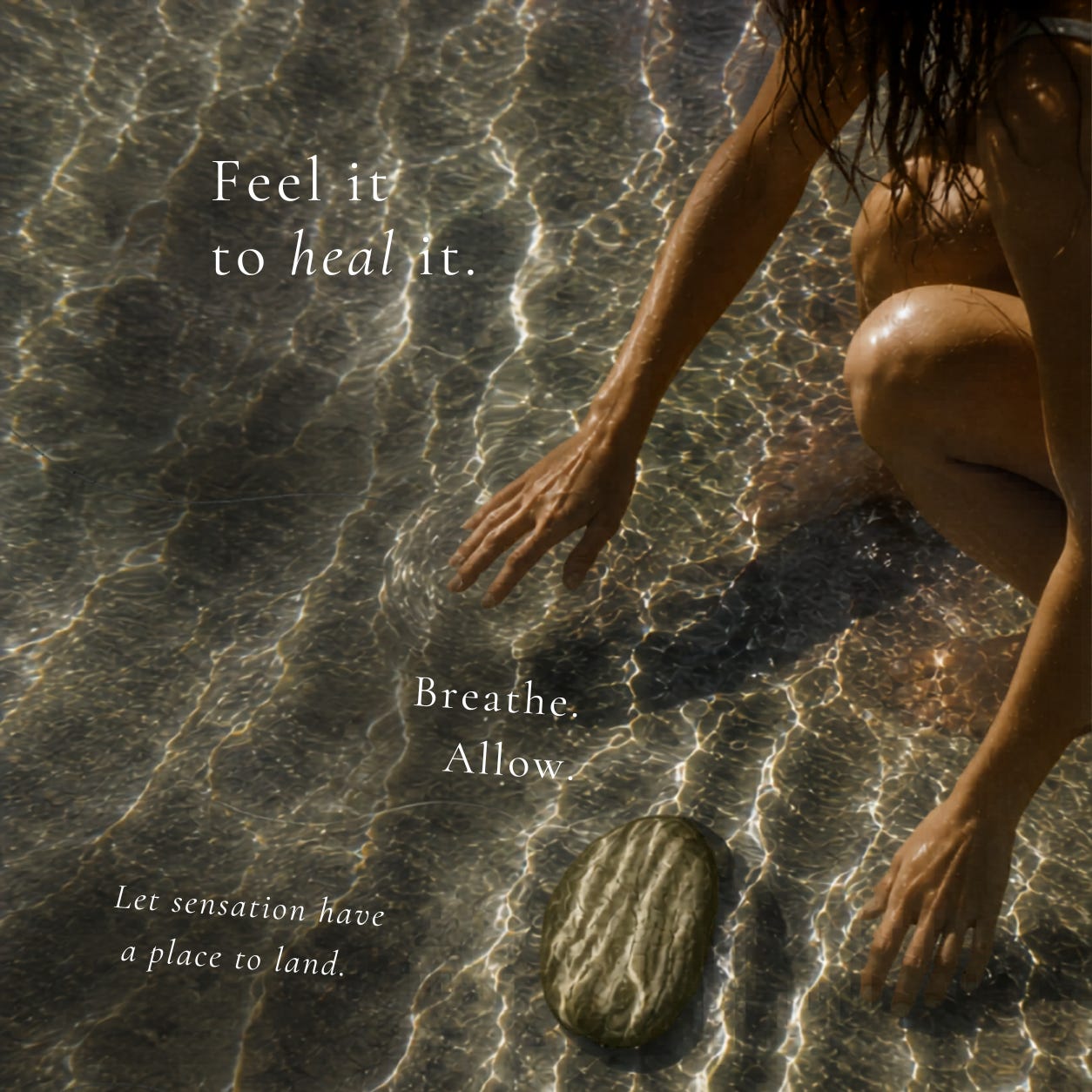
The Embodiment Guide exists at the intersection of the body and the modern world, exploring what it means to inhabit ourselves fully in an age that makes that increasingly difficult. Through writing, somatic practices, and the Haptic Body approach, we’ll be moving through the body together. Each part met with care. Each layer of holding approached with patience. The intelligence that lives beneath, uncovered gradually, tended over time.
That’s what this work has always been about. Coming home to the self that was waiting underneath everything else.
With warmth and embodied presence,
Megwyn